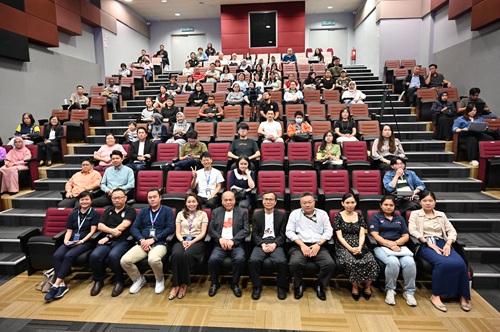
 The forum attendees with Tan Sri Chan (first row, fifth from left), Prof Dato’ Indera Ir Dr Lee (fifth from right) and Assoc Prof Dato' Dr Monna (fourth from left).
An academic forum held at TAR UMT Kuala Lumpur campus, on 22 November brought together leading experts in education, psychology, and public health to urgently address the rising tide of emotional distress among Malaysian students and to endorse a comprehensive policy framework: the 'Sekolah Selamat 2.0' proposal. The consensus among panellists was clear: mental health is no longer a peripheral issue but a critical survival skill requiring a multi-sectoral and systemic overhaul of the current education ecosystem. The forum was attended by Tan Sri Chan Kong Choy, Chairman of TAR UMT’s Board of Governors, and Alumni Council, Prof Dato' Indera Ir Dr Lee Sze Wei, President of TAR UMT, school counsellors and educators.
The forum began with a compelling keynote address delivered by Prof Dato’ Indera Ir Dr Lee. He stressed that mental health and emotional resilience in schools are a ‘very timely and very hot topics’ that concerns not just schools, but the whole society. He highlighted the increasing complexity of mental health in the digital age, noting that technology and its underlying algorithms can intensify the craving for emotional satisfaction, posing a dangerous downside. He issued a strong call to action, urging all stakeholders, including management, teaching staff, parents, families, and the government, to stop working in silos and collaborate, emphasising that prevention is always better than solving the problem after it escalates.
Associate Professor Dato' Dr Monna Ong Siew Siew, the lead researcher of the ‘Sekolah Selamat 2.0’ proposal, presented the initiative, which seeks to strengthen educational safety through new elements: psychological safety, mental well-being, digital literacy, and systematic, evidence-based intervention. This integrated system encompasses a support network connecting schools, parents, the local community, and health and safety agencies. Through this, it serves as the backbone of the national policy system, coordinating information and interventions across all sectors.
Dr Monna cited alarming statistics, including a 17.7% rise in recorded physical bullying cases from 2023 to 2024, and a 60% increase in students reporting symptoms of depression, anxiety, and post-pandemic stress. The proposed framework expands the definition of school safety from a physical focus to psychological, social, and emotional dimensions. The phased implementation plan includes a pilot test in 200 schools nationwide and the training of 10,000 teachers starting in 2026. She also proposed establishing a National Mental Health and School Crisis Intervention Council. This council will coordinate efforts between different agencies and manage the pilot testing of the new framework's proposal.
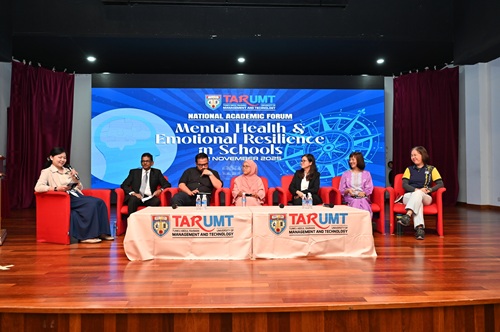 Assoc Prof Dr Lim Chia Yien (leftmost), the forum’s moderator, with all the panellists, namely (from second leftmost) Prof Dr Ananda Kumar, Dr Nazrul, Puan Imatul, Dr Chuah, Puan Tan, and Ms Wong.
The forum then proceeded with a dynamic panel discussion featuring experts from diverse fields, each providing practical and systemic perspectives:
Prof Dr Ananda Kumar A/L Palaniappan, Professor attached to the Faculty of Social Science and Humanities (FSSH), TAR UMT, identified systemic factors hindering students’ emotional resilience, particularly the degradation of peer support programmes (like Rakan Sebaya) and the strained teacher-student relationship. He attributed this strain to the excessive burden of administrative tasks placed on teachers, which limits their time for meaningful student engagement and support. Professor Ananda stressed that teachers are often not trained in social-emotional enhancement techniques. He proposed a cost-effective solution: a ‘360-degree evaluation, implementation and monitoring’ system where all stakeholders collectively identify and support at-risk students.
Dr Nazrul Azizi, the President of YoungMinds Malaysia, highlighted the emotional pressures faced by the current ‘hyperconnected’ generation of students. He argued that schools may be underestimating the need for emotional literacy and responsible gadget use. A primary recommendation was to train teachers and lecturers as Mental Health First Aiders (MHFA), acknowledging them as the true frontliners whom students approach before counsellors.
Puan Imatul Binti Nor Hazizan, the Psychology Officer at Titiwangsa Health Office, identified the biggest gap in the current school-to-health referral pathway as the lack of a structured system for the early detection of emotional distress, especially since students often exhibit ‘quiet symptoms’ like withdrawal, sleep deprivation, or somatic complaints (physical pain) rather than obvious behavioural issues. She proposed a practical, three-step protocol for teachers: daily/weekly ‘well-being temperature check-ins,’ 'flag' pattern monitoring, and quiet, respectful documentation/referral to combat the pervasive stigma that prevents students from trusting school counsellors.
Dr Chuah Hooi Mei, the Programme Leader of FSSH, TAR UMT, focused on the challenges faced by parents as primary caregivers, noting that a major barrier is the lack of a one-stop online platform for them to find reliable help and information, resulting in delayed intervention for their children. She agreed that stigma and low mental health literacy remain significant challenges. Furthermore, Dr Chuah pointed out that parents often lack confidence in school counsellors due to a poor understanding of the counselling process and a lack of regular follow-up or consultation regarding their child’s progress. She advocated for enhancing counsellor training to improve parental engagement and consultation.
Puan Tan Siew Choo, the Principal of SMJK Chong Hwa KL, stated that the biggest operational barriers are the vast amount of administrative tasks and KPIs (Key Performance Indicators) that overburden teachers, leaving them with insufficient time and knowledge to address students' mental health. She described a common systemic failing where the assumption that the teacher, counsellor, and management will handle an issue results in ‘nobody does it’. Puan Tan suggested a ‘quick win’ that school leaders can implement immediately: leveraging external stakeholders like alumni and Board of Governors to share real-world experiences with students, which helps shift the focus from solely academic results.
Ms Wong Su Zane, the Vice President of Life Line Association Malaysia, endorsed the multi-level crisis intervention model of Sekolah Selamat 2.0 as realistic. She explained that a student's struggle escalates to crisis when they experience isolation and a lack of support until a final ‘trigger’ causes them to collapse. To establish a minimum safety ecosystem, Ms Wong emphasised the necessity of a multi-sectoral approach that includes collaboration with the Ministry of Health and the Ministry of Women, Family, and Community, specifically Child Protective Services. On an interpersonal level, she urged all adults to ‘stop everything, drop everything, and listen’ when a student is willing to speak, and to change their opening question from ‘What's wrong with you?’ to the more empathetic ‘What happened to you?’.
The forum concluded on a constructive note, with shared aspirations that the Sekolah Selamat 2.0 proposal will continue to gain traction and contribute to building a school environment where psychological safety and student well-being are prioritised.